
 Cyberspace Work
 Cyberspace Pipeline
 Hesai Kosmo One
 NavVis MLX
 Handheld AR
 AR Pad
 All-in-One Appliance
 Buildings
 Rail & Transit
 Underground Pipelines
 Indoor Pipelines
 Industrial Plants
 Commercial Complexes
In Shenzhen, the operations lead at Shenzhen Water Technology’s Guangming Water Plant faces a practical question every day: once inspection crews arrive on site, where is the equipment, which route should they follow, how do they inspect concealed works, and where do they retrieve measurement point data? These questions often determine whether an inspection is efficient.
Traditional water plant operations rely on manual inspections, with fragmented data across departments. Equipment lists are separated from their locations, and there is a gap between data on the central control dashboard and data in the field. Inspections depend heavily on the experience of senior technicians, while remote supervision struggles to track attendance, routes, and records in real time. Many problems only surface once crews are already on site.
CyberSpace and Shenzhen Water Technology have partnered to deploy an AR smart operations and maintenance system at Guangming Water Plant. Built around a “reality-based digital twin + AR” approach, the system brings real plant conditions into modeling, inspection, and management workflows, enabling teams to identify and resolve conflicts before they reach the site.
“Traditional digital twins often stop at ‘dashboard visualization’ and struggle to empower frontline teams,” the project team said in its solution overview. “We wanted to use reality-based digital twins and AR to make the leap from data that can be ‘seen’ to data that can be ‘used.’”
1. Bringing real site conditions into water O&M workflows
Traditional measurement and drawings remain important, but they cannot fully capture the complex reality of a plant. If a traditional digital twin relies on simple modeling, it can look impressive but fail to show the internal complexity of the environment.
The system uses high-precision 3D scanning and information calibration, integrating oblique imagery, BIM, point cloud, and panoramic data to build a 1:1 reality-based digital twin of the plant. Pumps, pipes, valves, and other assets are faithfully represented. Key equipment is accurately mapped in space, and measurement point data is bound to spatial locations.
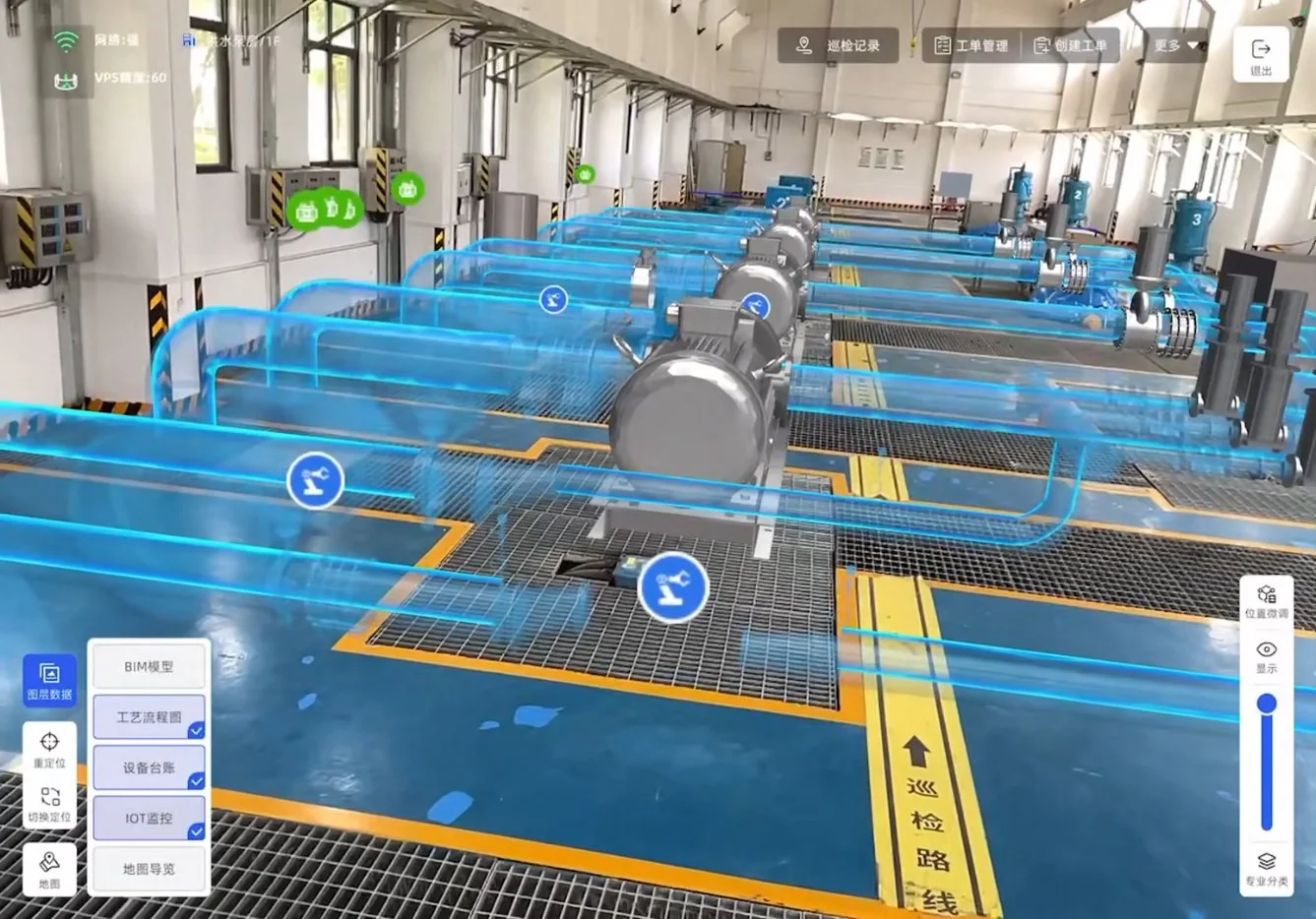
This allows teams to review equipment positioning, concealed works, inspection routes, base conditions, and potential conflicts in the model before going on site. In the Guangming Water Plant deployment, daily inspection efficiency increased by 60%, equipment list lookup efficiency rose by 80%, and fault response and decision-making efficiency improved by 60%. Lookups moved from “hours” to “seconds.”
Positioning now runs as one closed loop across the site: high-precision RTK for the outdoor sedimentation tanks, visual positioning inside the supply pump rooms, and multi-device data display in the chemical dosing room. Inspectors get faster rounds and a record that survives shift changes, while O&M cost and safety risk both come down.
“Our goal was not to build another dashboard, but to make data truly serve the frontline,” the project team said. For the customer, this means less rework, fewer transport requirements, lower labor costs, and reduced safety risk.
2. Making the proposed O&M approach easier to understand
In traditional workflows, equipment lists are locked in databases, while data is centralized on the control room dashboard. Frontline staff struggle to retrieve it, and different roles see only fragments of the picture. Communication easily breaks down.
The system binds equipment lists precisely to spatial locations and uses AR to project equipment information into the real-world environment. The reality modeling platform supports remote supervision, inspection task creation and dispatch, and work order reporting. The AR mobile app provides inspection task information, route guidance, concealed and non-concealed equipment locations, real-time measurement point data, and query/feedback functions.
Managers, frontline inspectors, and cross-departmental teams can therefore share the same visual view: how the plan corresponds to existing structures, where equipment is located, what the data shows, and which route to follow. Project teams can align expectations earlier and reduce on-site explanation and repeated confirmation.
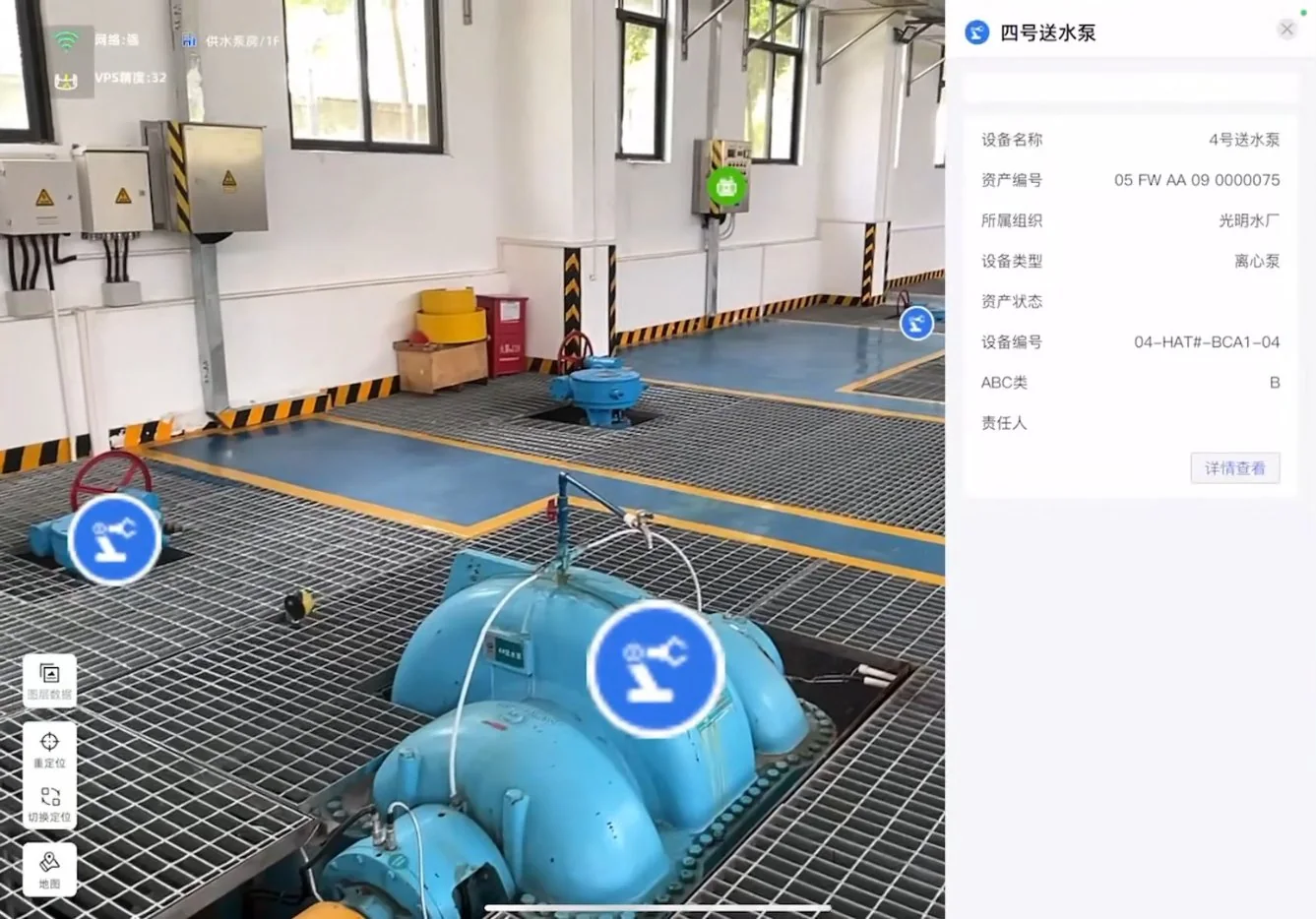
“Compared with traditional inspections, where staff must look up data one by one on a phone, this system uses AR to visualize measurement point data in real time,” the project team said.
3. Helping water teams build their own inspection and data capture capabilities
The project began with system deployment and professional support, then gradually enabled the plant team to use AR devices for daily inspections and data capture on their own. With a lower operational barrier, frontline staff can get up to speed faster.
The system uses AR visual guidance to restructure inspection workflows, providing standardized job navigation and operating prompts. Distance limits ensure that on-site staff reach the correct location. Staff can use gestures to record information, take photos, and generate a digital work order for one-click reporting when anomalies occur. Managers can view inspection routes and timelines in real time and retain inspection records, making every inspection fully traceable.
This not only improves inspection efficiency but also helps the plant build its own digital O&M capability. For CyberSpace and Shenzhen Water Technology, it also opens new possibilities: supporting professional scanning and system deployment while helping customers develop internal capture and inspection capabilities, creating a repeatable standardized solution.
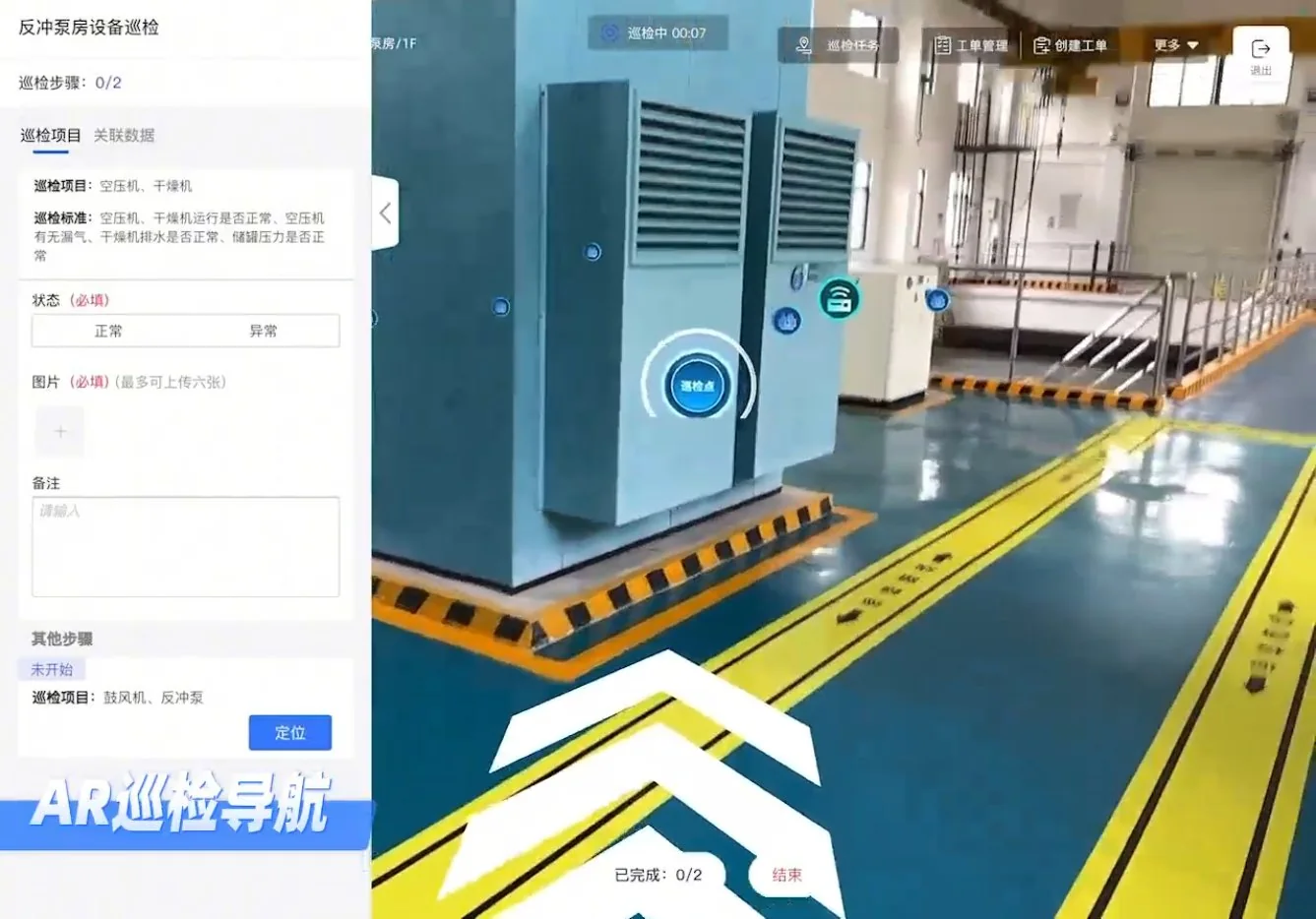
“Frontline staff can use gestures to record information, take photos, and generate a digital work order for one-click reporting when anomalies occur,” the project team said. “Every inspection is fully traceable, helping managers supervise more efficiently.”
4. Taking the same idea beyond the water industry
Water plants are the core scenario of this deployment, but similar challenges exist beyond the water sector. Municipal, industrial facility, construction, and engineering teams also lose time to repeated measurements, incomplete field information, rework, and problems discovered too late.
The Guangming Water Plant practice shows that reality-based digital twins plus AR field interaction can form a more general method: first capture the real environment, then bring that information back to the office for modeling, planning, and communication, and finally put it directly into the hands of frontline staff on site.
“The successful deployment of the AR smart O&M system at Guangming Water Plant validates the enormous value of the ‘reality-based digital twin + AR field interaction’ technical path,” the project team said. It not only improves O&M efficiency and safety, but also provides a standardized, replicable, and scalable smart upgrade solution for water and broader municipal and industrial facility operations.
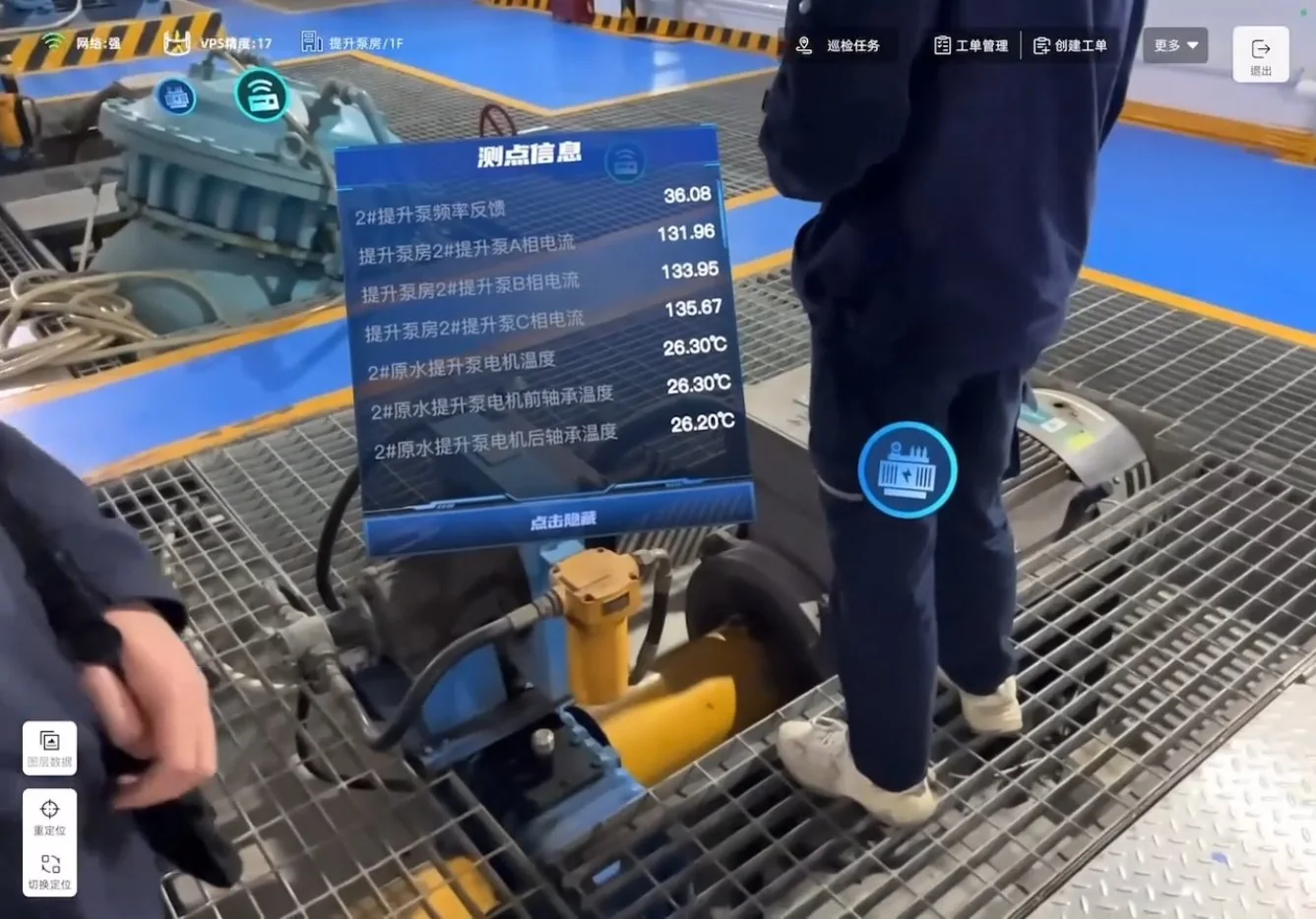
Whether it is water plant inspections, scaffold design, or other projects that depend on site conditions, teams face the same common challenge: understand the site accurately before work begins. The value of reality-based digital twins and AR digital-physical fusion is not another visualization dashboard. It is bringing real site conditions into the workflow so problems are found earlier and frontline teams can work more efficiently.
Want to see how real site conditions can be brought into your modeling and O&M workflows? Explore CyberSpace’s AR smart O&M workflow, or contact the team for more details on the Guangming Water Plant case.
About this engagement
AR smart operations and maintenance for Shenzhen Water Technology’s Guangming Water Plant, delivered on the CyberSpace platform: a 1:1 reality-based digital twin fusing oblique imagery, BIM, point cloud and panoramic data, equipment lists and measurement points bound to spatial positions, and AR-guided inspection from task dispatch to recorded closure. Reported outcomes: +60% daily inspection efficiency, +80% equipment list lookup efficiency, and +60% fault response and decision-making efficiency.